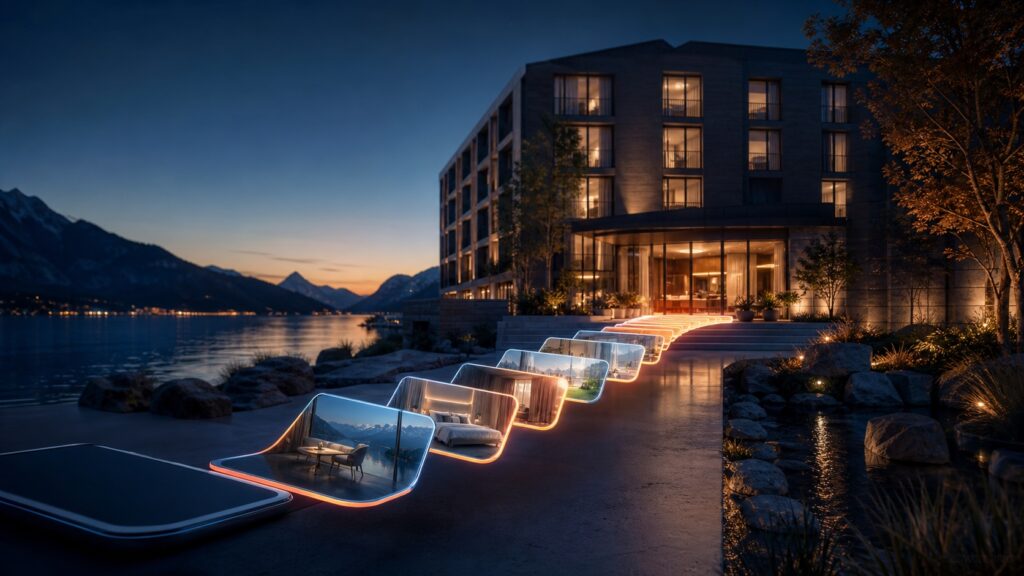
A Swiss hotel website should be designed around direct-booking continuity, not a gallery-first homepage. Guests need to move from destination interest to room comparison, total-price confidence and confirmation without losing dates, language or trust when the booking engine opens. For an independent hotel, a professional redesign commonly needs a planning budget of CHF 8,000–20,000; multilingual properties, resorts and integrations can require CHF 20,000–50,000+. The decisive scope is the booking journey, photography, content, languages, property-management connections and post-launch measurement.
Switzerland recorded 42.8 million hotel overnight stays in 2024, according to the Federal Statistical Office. That demand does not guarantee direct revenue: hotels still compete with online travel agencies, metasearch results and every uncertainty a guest encounters between inspiration and payment.
The hotel website has one commercial job
Its job is to help the right guest choose the property and complete a direct reservation with confidence. Brand storytelling supports that decision; it is not the decision. A cinematic video that delays room information can reduce confidence. A minimal site that sends guests into a visually unrelated booking engine can feel like a hand-off to an unknown supplier.
The direct-booking confidence funnel
Method note: decision stages, not measured conversion percentages.
Choose the right hotel website scope
Hotel website scope finder
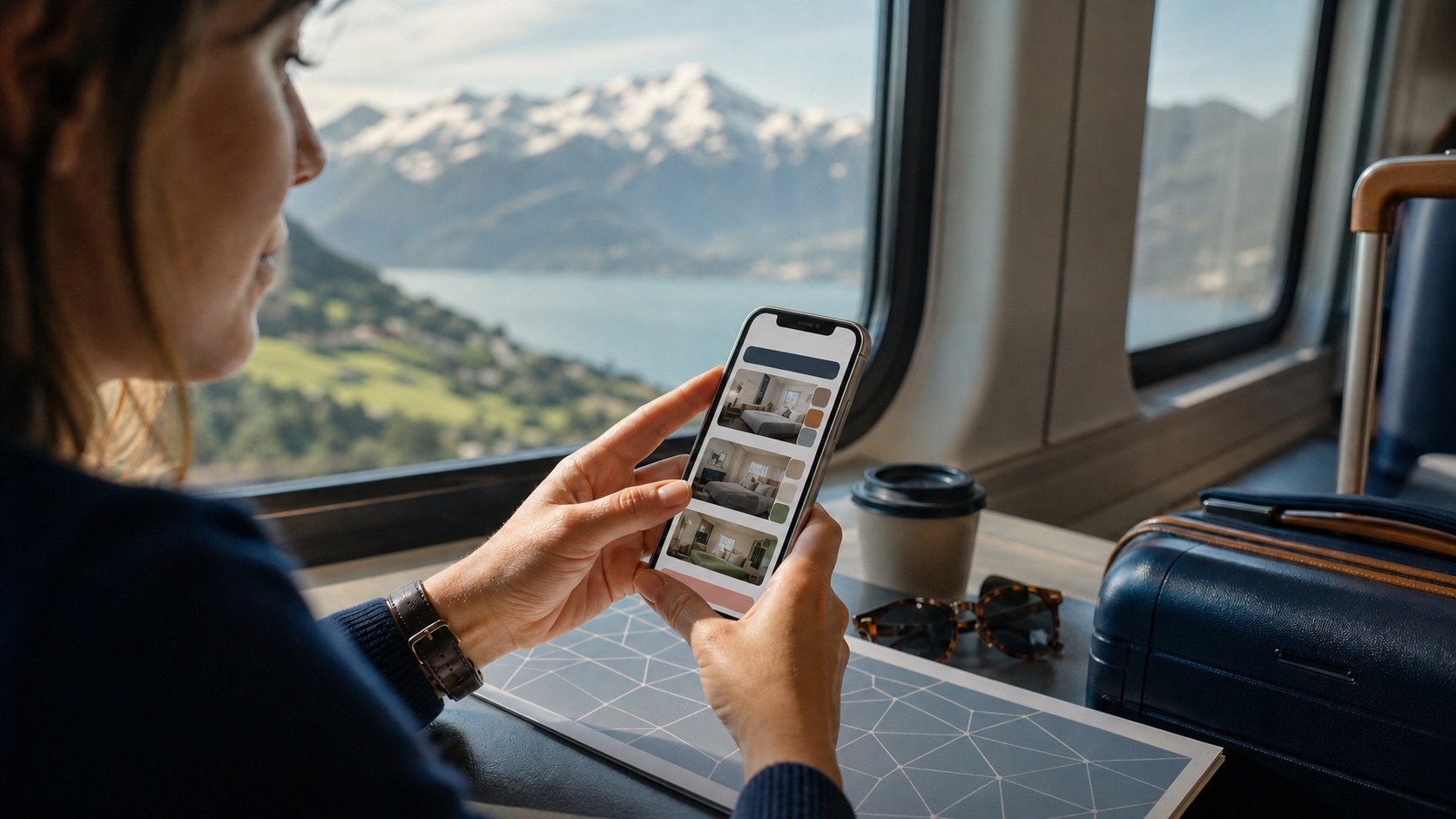
What the website must answer before “Book now”
Why this property?
Describe the real fit: location, atmosphere, service model and trade-offs. “Unforgettable luxury” gives the guest nothing to choose with.
Which room?
Show meaningful differences in size, view, bedding, occupancy, accessibility, cancellation and included services.
What will I pay?
Keep rate, tax, fee and cancellation information consistent with the booking engine and Google Hotel feeds.
What happens next?
Maintain selected dates, room and language; make confirmation, modification and support routes obvious.
The website and booking engine are one experience
Guests do not care which vendor owns each screen. Typography may change, but dates, availability, room names, photos, currency and policies must remain coherent. Google’s Hotel Center guidance stresses price accuracy and a landing page where the selected room and rate are easy to find. Free booking links can send guests directly to an official booking page at no click charge, but the landing experience and feed accuracy still matter.
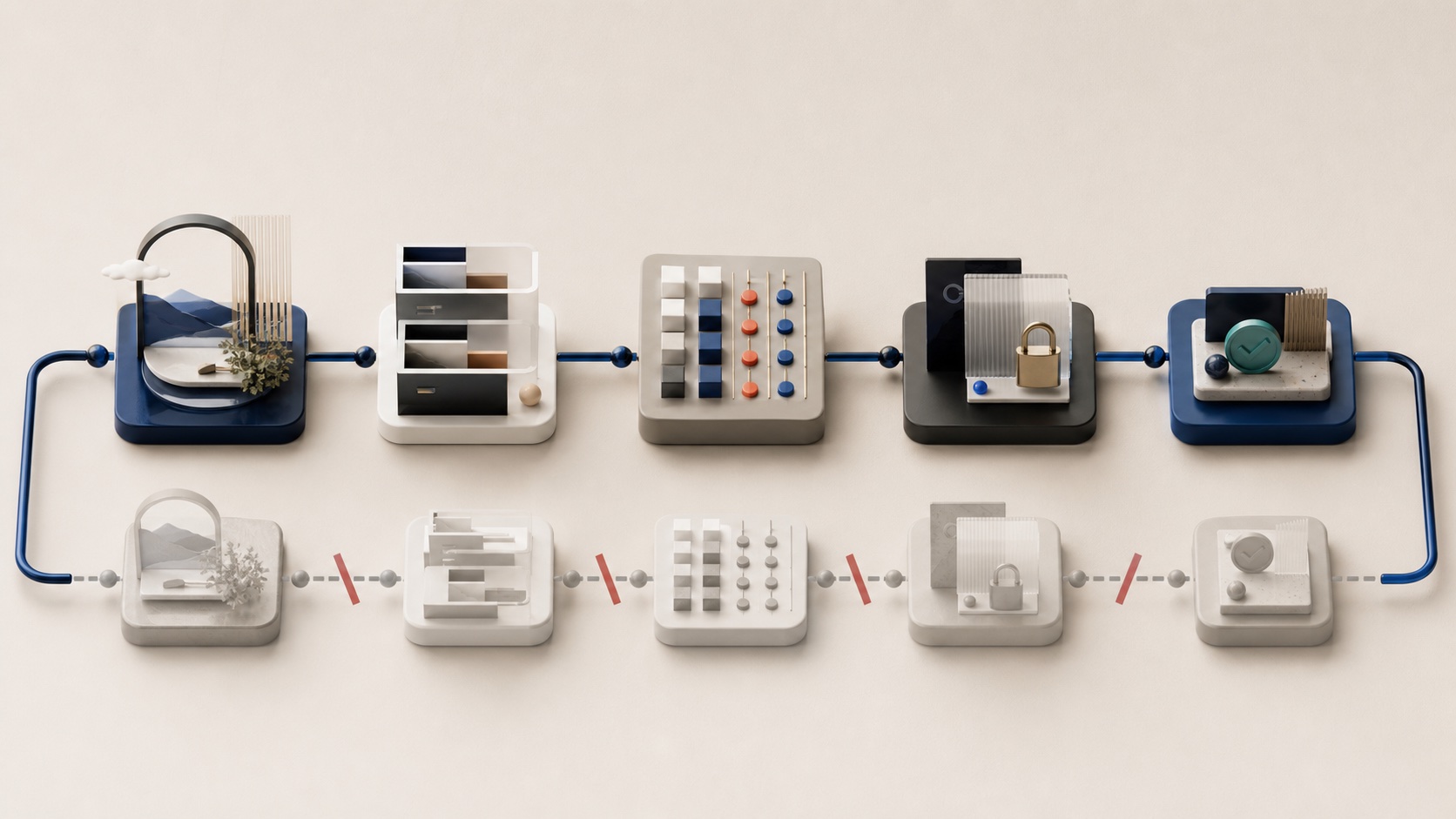
Essential hotel website workstreams
| Workstream | What good looks like | Failure to avoid |
|---|---|---|
| Strategy | Defined guest segments, direct-booking proposition and measurable journey | Designing for “everyone” |
| Photography | Consistent room, bathroom, view and shared-space coverage with usage rights | Only atmospheric details |
| Room content | Comparable facts, accessible options and honest limitations | Identical descriptions with different names |
| Languages | Localised search intent, policies and booking hand-off | Machine translation without editorial review |
| Booking integration | Dates, room, language, campaign and analytics continuity | Generic booking-engine homepage |
| SEO and Hotel Center | Property data, useful landing pages, accurate prices and structured data | Schema that disagrees with visible prices |
| Accessibility | Keyboard, contrast, form errors, room meaning and accessible booking path | Overlay presented as compliance |
Multilingual architecture deserves its own budget. See our guide to multilingual SEO in Switzerland. Accessibility should also be specified early; our Swiss accessibility guide explains the practical WCAG target.
Hotel website design cost in Switzerland
| Scope | Planning range | Usually includes |
|---|---|---|
| Focused independent-hotel refresh | CHF 8,000–15,000 | Core templates, room presentation, mobile UX and booking-engine styling |
| Multilingual direct-booking site | CHF 15,000–30,000 | Strategy, content architecture, languages, SEO, photography direction and integration |
| Resort or multi-property system | CHF 25,000–60,000+ | Packages, experiences, multiple properties, data connections and extensive testing |
| Continuous optimisation | Monthly or quarterly programme | Analytics, experiments, seasonal content and booking-path QA |
These are Clear Design Experts planning ranges, not market averages. Booking-engine licences, PMS/channel-manager work, photography, translation and maintenance may sit outside the build quote. Compare them with the broader website cost framework for Switzerland.
Questions to ask before hiring
- Which direct-booking metrics will the redesign improve?
- How will the booking engine preserve dates, room, language and campaign attribution?
- Who owns room copy, photography, translations and rate-policy accuracy?
- How will Google Business Profile, Hotel Center and structured data stay consistent?
- Which real mobile and accessibility tests are included?
- Who monitors forms, booking links, price accuracy and analytics after launch?
Sources and methodology
Checked 5 July 2026 against the Swiss Federal Statistical Office’s accommodation statistics and Google’s official Hotel Center documentation for free booking links, landing-page and price best practices, and hotel price structured data. Cost ranges are planning allowances, not published industry averages.
Audit the booking journey, not just the homepage
Clear Design Experts can review your hotel website, room presentation, mobile booking hand-off, language structure and measurement. You receive a prioritised direct-booking plan before investing in a full redesign.